Morse code alphabet chart
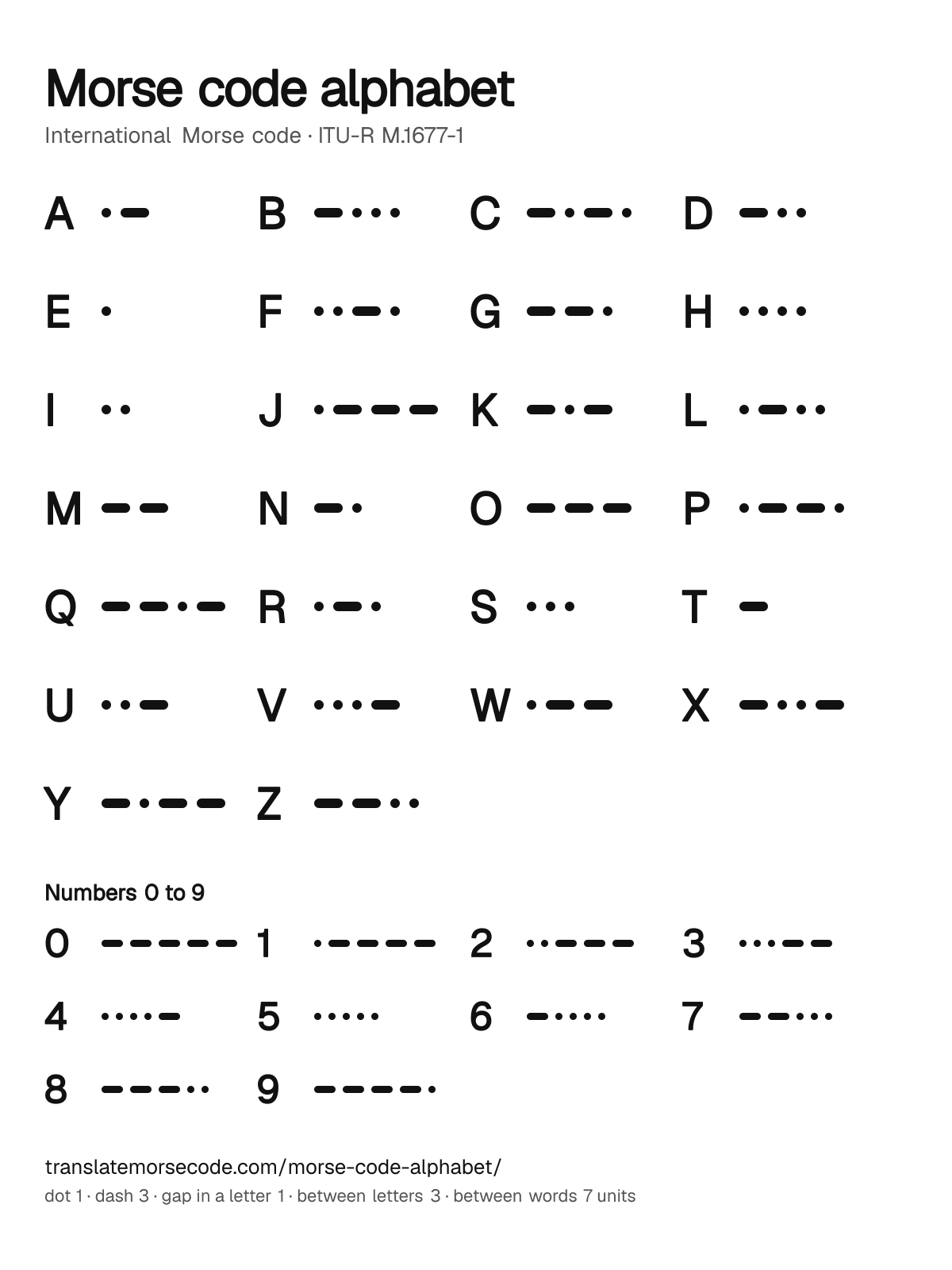
Morse code writes each letter as a short pattern of dots and dashes. This is the International Morse code alphabet as the ITU sets it: press play on any character, look up a pattern you have, or download the chart as a PDF to print.
A to Z, then 0 to 9: 48 seconds at 15 WPM.
Letters A to Z
The 26 letters, A to Z. Common letters got the shortest codes: E is a single dot, while rare letters like Q and J take four elements. Open a letter for its own page.
How to read the chart
Each card holds one character. The bars draw its dots and dashes to scale: a dot is one unit long, a dash is three, and the gap between them is one unit. Read them left to right. Under the bars is the code written out, and on the letter cards its length in units and how operators say it: a dot is “di” (“dit” at the end) and a dash is “dah”, so A is di-dah. Use the chart as a cheat sheet or a lookup table for codes. To read Morse by ear, learn each letter’s sound with the Koch trainer. The Morse code tree shows the same codes as branches: a dot goes left, a dash goes right.
Examples
Three things to try with the chart:
| You have | Do this | Result |
|---|---|---|
| A word to send: HELLO | Find each letter on the chart | .... . .-.. .-.. --- |
A message to read: -- --- .-. ... . | Look up each group between the spaces | MORSE |
One pattern you heard: ...- | Type it into Look up a code | The chart narrows to V, 3, $, Understood (SN) and End of work (SK), the characters whose code starts with ...-; V is the exact match |
SOS is ... --- ... letter by letter, but it is sent as one signal with no gaps between the letters: ...---.... Its own page is SOS in Morse code.
Patterns that make the chart easy
Many codes come in families, which makes the chart easier to learn and to check. This table is built from the same codes as the chart.
| Pattern | Characters |
|---|---|
| Only dots | E ., I .., S ..., H .... and the digit 5 ..... |
| Only dashes | T -, M --, O --- and the digit 0 ----- |
| Read backwards | A and N, B and V, D and U, F and L, G and W, Q and Y |
| Dots and dashes swapped | A and N, B and J, D and W, E and T, F and Q, G and U, I and M, K and R, L and Y, O and S, P and X |
For a memory hook for each letter, see Morse code mnemonics.
Numbers 0 to 9
Every digit has exactly five elements. From 1 to 5 the dots grow from the left; from 6 to 0 the dashes do. That makes 0 five dashes, so do not confuse it with O, which is three. Numbers guide
Punctuation in the ITU standard
These are the punctuation marks defined in ITU-R M.1677-1. Some share a code with a procedural signal, so read them from context. The @ sign was added in 2004. Punctuation guide
Symbols outside the standard
You will see these in charts and software, but they are not part of the ITU standard, so not every operator will copy them. Dashed cards mark them.
Accented letters
É is the only accented letter in the ITU standard. The others are national extensions, used mainly between operators who share the language. Many operators simply send the plain letter, or spell Ü as UE. Accented letters guide
Service signals
The ITU also defines a few signals that manage the conversation itself. They are sent as one character with no gaps, and written as the letters run together with a bar over them. For prosigns such as AR and KN, and the Q codes and abbreviations operators send, see Morse code abbreviations.
Phonetic alphabet and Morse code
The ICAO spelling alphabet, also called the NATO or military phonetic alphabet, gives each letter a word for voice radio: Alfa for A, Bravo for B, Charlie for C. Morse code sends the letter itself as a signal. The two are often printed together, so here they are side by side, with a play button for each code. To spell any word aloud, use the NATO phonetic alphabet chart and translator.
| Letter | Phonetic word | Morse code |
|---|---|---|
| A | Alfa | dot dash |
| B | Bravo | dash dot dot dot |
| C | Charlie | dash dot dash dot |
| D | Delta | dash dot dot |
| E | Echo | dot |
| F | Foxtrot | dot dot dash dot |
| G | Golf | dash dash dot |
| H | Hotel | dot dot dot dot |
| I | India | dot dot |
| J | Juliett | dot dash dash dash |
| K | Kilo | dash dot dash |
| L | Lima | dot dash dot dot |
| M | Mike | dash dash |
| N | November | dash dot |
| O | Oscar | dash dash dash |
| P | Papa | dot dash dash dot |
| Q | Quebec | dash dash dot dash |
| R | Romeo | dot dash dot |
| S | Sierra | dot dot dot |
| T | Tango | dash |
| U | Uniform | dot dot dash |
| V | Victor | dot dot dot dash |
| W | Whiskey | dot dash dash |
| X | X-ray | dash dot dot dash |
| Y | Yankee | dash dot dash dash |
| Z | Zulu | dash dash dot dot |
International and American Morse code
The chart above is International Morse, the code the ITU sets and the one used on the air today; its official text is ITU-R Recommendation M.1677-1 (2009). American Morse, also called Railroad Morse, is the older code of the US telegraph lines, and 11 of its letters differ. Some have a short space inside them (American C is .. .), L is a long dash, and others use another letter’s International code: American F is International R. The translator plays both: pick American in its code table menu. The American Morse code guide covers its history and every letter.
| Letter | International | American |
|---|---|---|
| C | dash dot dash dot | two dots, a short space, then one dot |
| F | dot dot dash dot | dot, dash, dot (International R) |
| J | dot dash dash dash | dash, dot, dash, dot (International C) |
| L | dot dash dot dot | a long dash |
| O | dash dash dash | two dots with a short space between them |
| P | dot dash dash dot | five dots |
| Q | dash dash dot dash | dot, dot, dash, dot (International F) |
| R | dot dash dot | one dot, a short space, then two dots |
| X | dash dot dot dash | dot, dash, dot, dot (International L) |
| Y | dash dot dash dash | two dots, a short space, then two dots |
| Z | dash dash dot dot | three dots, a short space, then one dot |
Timing rules
Everything is counted in units, the length of one dot. Speed is measured with the word PARIS: at 20 words per minute a unit lasts 60 milliseconds. Written Morse puts one space between letters and a slash between words, so HI THERE is .... .. / - .... . .-. .. PARIS on a timing ruler
- Dotthe unit1 unit
- Dashthree dots long3 units
- Gap inside a letterbetween its dots and dashes1 unit
- Gap between lettersone dash of silence3 units
- Gap between wordsthe longest pause7 units
Print or download the chart
The PDF puts the 26 letters, the numbers 0 to 9 and the ITU punctuation on one sheet, in black on white so it prints cleanly, sized for A4 or US Letter. The PNG image shows the letters and numbers, for a pin board or a slide. The wallet card puts A to Z on one side and 0 to 9 on the other: print it at actual size, cut it out and fold it to the size of a bank card. All of them are made from the same table as the chart above, so the reference sheet always matches it. To carry Morse on your phone, the wallpaper maker turns a word or a name into a lock-screen wallpaper. For a tattoo, the tattoo designer shows a word in Morse at its real size and makes a stencil for your artist.
Learn the alphabet
Reading the chart is a start; hearing the letters is how they stick. All lessons
- Koch trainerLearn at full speed, two letters at a time.
- Quiz and flashcardsTest yourself on the whole chart.
- Listening practiceCopy real words by ear.
- Sound-alike drillTell apart letters that sound alike, like E, I, S and H.
- Printable worksheetsMorse code worksheets to print, with an answer key.
- Poster makerA poster of a word, a date or the alphabet in Morse, to print.
Guides: What is Morse code?, Morse code mnemonics for every letter, How to learn Morse code
Frequently asked questions
About the Morse code alphabet and this chart
What is the whole alphabet in Morse code?
The International Morse alphabet has 26 letters, from A .-, B -... and C -.-. to X -..-, Y -.-- and Z --... E is the shortest, a single dot, and T is a single dash. Every letter is on the chart above with a play button, and Play the whole alphabet sounds A to Z and then 0 to 9 in order.
What does Morse code sound like?
Morse code sounds like a steady beep switched on and off: a short beep for a dot, said "dit", and a beep three times as long for a dash, said "dah". The play buttons on this chart use a 600 Hz tone at 18 words per minute, where a dot lasts about 67 milliseconds. For SOS, telegraph clicks and ship radio, play the clips in Morse code sound effects.
What do three dots mean in Morse code?
Three dots, ..., are the letter S. Three dashes, ---, are O, and SOS is the two sent as one signal, ...---.... Count carefully, because dots alone make several characters: one dot is E, two are I, four are H and five are the digit 5. To check a pattern, type it into Look up a code above the chart.
What are the dots and dashes in Morse code called?
Operators call them dit and dah, after the way they sound, and each one is an element of the character. A dot lasts one unit, the basic measure of Morse timing, and a dash lasts three. How long a unit is depends on the speed, counted in words per minute with the word PARIS: at 20 WPM a unit is 60 milliseconds and at 10 WPM it is 120.
How do I say "I love you" in Morse code?
I love you is .. / .-.. --- ...- . / -.-- --- ..-: I, then LOVE, then YOU, with a slash for each gap between words. The number 143 is not Morse code; it is pager shorthand that counts the letters in each word. In Morse, 143 is .---- ....- ...--. The I love you in Morse code page plays it and links to tools that flash it or make it into a bracelet.
Can I print this chart or download it as a PDF?
Yes. Download the chart as a one-page PDF sheet sized for A4 or US Letter, or as a PNG image. The PDF holds the letters, the numbers and the ITU punctuation, in black on white. For your pocket there is a wallet-size card to print, cut and fold. Print or save as PDF also works: the printout keeps the chart and leaves out the menus. For classroom sheets with an answer key, use the Morse code worksheets.
Is Morse code still used today?
Yes, though no longer as an everyday way to send messages. Amateur radio operators still send it, aviation radio beacons identify themselves in it, and the US Navy still trains operators in it. Ships moved to satellite distress systems by 1999. The guide Is Morse code still used? lists each use with its source.
What is the easiest way to learn the Morse alphabet?
Learn it by sound rather than from the chart. A chart is for looking codes up; reading Morse at speed means knowing each letter's rhythm by ear. The Koch trainer starts with two letters at full speed and adds one at a time, and the Morse code quiz tests the whole chart. Then copy real words in listening practice. The patterns above and the Morse code mnemonics guide help the codes stick.